 how-to
How to Choose Custom Engraved Gifts: 2026 Guide
Table of Contents
- Start With the Occasion and the Recipient
- Best Materials for Laser Engraving
- How to Write a Meaningful Engraving Message
- Personalized Gift Engraving Ideas That Fit the Milestone
- Font Selection, Monograms, and Engraving Placement
- Budgeting for Personalization Without Cutting Corners
- How to Vet a Custom Engraved Gifts Provider
- Frequently Asked Questions
Last Updated: September 13, 2026
Start With the Occasion and the Recipient
Learning how to choose custom engraved gifts starts with two questions, not a catalog: the occasion sets the tone, and the recipient sets the rules. A retirement plaque and a wedding keepsake call for different materials and messages.
At Swift Creek Giftworks, we see the same pattern: people who pick the item first compromise on the message.
Work through this sequence before you browse:
- Name the milestone. A birthday, anniversary, wedding, or service award each carry their own conventions.
- Picture where the gift will live. Display context decides size and material.
- Note the recipient's taste. An engraved piece that clashes with the room never gets displayed.
- Set your budget ceiling before you fall in love with an item.
The occasion also dictates timing: wedding party favors and corporate recognition orders need lead time for proofs and production.
Best Materials for Laser Engraving
The best materials for laser engraving are hardwoods, glass and crystal, coated or bare metals, and full-grain leather. Each takes a mark differently in contrast, durability, and aging.
Material compatibility is the most common source of disappointment in personalized gifts: a design that looks striking on walnut can disappear on clear glass. The deeper question is what the engraving looks like in five years.
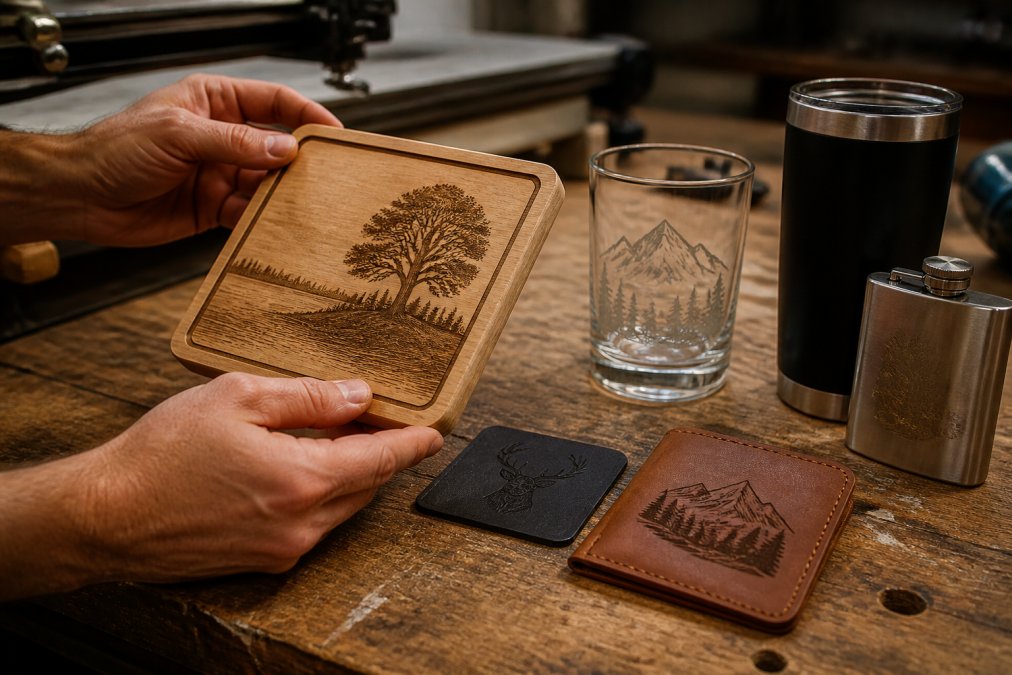
Wood, Glass, Metal, and Leather Compared
Each material rewards a different kind of design. Here is how they stack up on the factors that matter most:
| Material | Mark Style | Durability | Best For | Watch Out For |
|---|---|---|---|---|
| Hardwood | Dark, high contrast | Very high | Plaques, boards, boxes | Grain can fight fine detail |
| Glass and crystal | Frosted, subtle | High | Awards, barware, keepsakes | Fragile in shipping |
| Coated metal | Bright, crisp | Very high | Keychains, tumblers, tags | Bare metal shows scratches |
| Leather | Debossed, tonal | Moderate | Wallets, journals, luggage tags | Absorbs moisture over time |
Hardwoods give the deepest contrast without color fill, which is why they dominate heirloom plaques. Glass produces a soft, frosted mark that can vanish under certain lighting. Coated metals hold crisp, bright marks, while bare brass and stainless develop a patina.
Leather sits in its own category: a debossed monogram looks refined, but leather is the least forgiving surface for fine serif fonts and thin line art.
How Each Material Ages, The Durability Guide Most Guides Skip
The engraving itself rarely fails, the surface around it does, making material choice a long-term decision.
Hardwood. A laser mark on hardwood is a controlled burn and permanent, but the wood around it moves. Solid wood expands and contracts with humidity, and an unfinished board near a kitchen window can crack through the engraving; a food-safe oil finish once or twice a year keeps it stable (woodmagazine.com). Walnut and cherry darken with age, making wood the safest bet for decades of display.
Glass and crystal. The frosted mark is etched into the surface and won't fade, but glass chips at edges, and a chip crossing the engraving can't be repaired without re-polishing the face. High-lead crystal scratches easily in a dishwasher, so hand-wash anything engraved; for shelf-bound awards and barware, glass is effectively permanent (thespruce.com).
Coated metal. Anodized aluminum and powder-coated steel hold a bright mark because the laser removes the coating to reveal the substrate. That contrast is also the weakness: any scratch deep enough to breach the coating creates a bright line competing with the engraving, which tumblers and keychains show within a year or two. Bare stainless and brass are the opposite, subtler at first, but the whole surface patinas together.
Leather. Debossing compresses fibers that relax over time, so a crisp monogram on a new wallet softens with daily handling. Moisture is the real enemy: a rain-soaked luggage tag darkens and stiffens unevenly around the mark. Full-grain leather outlasts bonded or corrected-grain by a wide margin, so the grade matters more than the engraving method.
Matching the Material to Where the Gift Will Live
Display context should override aesthetics: a desk piece in a climate-controlled office can be almost anything, but a kitchen board, keychain, garden marker, or child's keepsake each impose their own rules.
- Kitchen and bar: hardwood boards and bare stainless steel. Skip coated tumblers if they will be washed daily.
- Outdoor or garage: bare brass, stainless, or pressure-treated wood. Coated finishes and leather will not survive.
- Jewelry box or shelf: glass, crystal, and fine hardwood. These reward close inspection.
- Daily carry: full-grain leather or bare metal. Choose a material that wears well.
Repeat buyers often order one sample in the intended material before a bulk run. It costs a little more up front and eliminates the most expensive mistake in personalized gifting: fifty identical pieces in the wrong material.
How to Write a Meaningful Engraving Message
A meaningful engraving message answers one question: what would this person be glad to read in ten years? That usually means fewer words, not more. The strongest inscriptions name a relationship or a moment, not a generic sentiment.
A custom message works best when it follows a simple formula:
- Anchor: a name, nickname, or initials
- Marker: a date, place, or milestone
- Heart: one short line that only the two of you would understand
"Ines & Ray, Est. 2019" beats a paragraph every time, and a single inside joke beats a borrowed quote. If you're stuck, write three versions, set them aside for a day, then read them aloud; the one that still lands is the one to engrave.
Character Limits and Legibility Constraints
Character limits exist because physical space does. A standard tumbler band fits roughly 20 to 30 characters per line across two or three lines, while a small pendant may fit fewer than 15 total. Ask your provider for the exact limit before finalizing wording.
Legibility is the harder constraint: thin fonts, script faces, and tight spacing collapse when scaled to a small surface. The smaller the item, the simpler the font and the shorter the message.
Personalized Gift Engraving Ideas That Fit the Milestone
The right engraving idea depends on the milestone. Starting points for common occasions:
- Weddings: the couple's names and wedding date on a serving board, or a short vow fragment on a keepsake box. Wedding party favors often carry just initials and the date.
- Anniversaries: a specific date, a map coordinate from where you met, or a line from a first letter.
- Birthdays: an inside joke, a birth date, or a hand-drawn signature reproduced as line art.
- Graduations: name, degree, and graduation year on a pen, portfolio, or desk piece.
- Corporate recognition: employee name, years of service, and a company mark on an award or desk accessory. Corporate gifting works best when the design stays restrained.
The throughline is specificity: a bespoke gift earns its sentimental value from details that could only belong to one person.
Font Selection, Monograms, and Engraving Placement
Font selection, monogram style, and placement decide whether a piece reads as considered or cluttered. But first you need to know which engraving technique will produce the mark, because the technique, not the font list, sets the real limits on detail.
The Four Engraving Techniques and What Each One Can Do
- Laser engraving. A focused beam vaporizes or carbonizes the surface, producing fine detail on wood, glass, coated metal, leather, and some plastics with no physical contact. It's the most common method for personalized gifts because setup is fast and the mark is consistent across a run. The trade-off is contrast: on bare metal and clear glass, a laser mark can be subtle unless treated or deep enough to frost.
Font Selection by Technique
Match the letterform to both message and method. Serif faces suit formal, traditional inscriptions. Clean sans-serif suits modern and corporate work and is safest for laser engraving, where thin strokes disappear. Script adds warmth but needs generous space and a simple layout.
Never mix more than two fonts on one item. A single well-chosen face almost always looks better than a busy pairing.
Monogram Conventions
Monograms follow their own rules, and getting them wrong is one of the few engraving mistakes a recipient will notice immediately.
- Three-letter traditional: first, last, surname initial larger in the center
- Couple's monogram: two first initials flanking a shared surname initial
- Single initial: cleanest option for small surfaces like cufflinks or charms
For a couple, confirm the order before engraving. Traditional etiquette places the shared surname initial in the center and larger, but many modern couples prefer their own first initials centered. Ask; do not assume.
Placement That Looks Intentional
Placement matters as much as the mark itself. Center the engraving on flat, symmetrical items; on curved or handled objects, place it where the recipient's hand or eye naturally lands, not where the machine finds it easiest. Crowding it against an edge or seam makes the piece look off-balance.
On functional items, avoid placing the mark where it will wear. The inside of a ring, the back of a watch case, and the underside of a board are all traditional for a reason: they protect the engraving from daily contact. On display pieces, put the mark where it will be seen.
Budgeting for Personalization Without Cutting Corners
Personalization pricing scales with complexity, not sentiment. A single-line monogram costs far less than a multi-line message with a logo, because setup, proofing, and machine time all increase with detail. Providers typically quote on item, engraving area, number of lines, and whether artwork needs redrawing.
Where people overspend: elaborate artwork on an item that will sit in a drawer. Where people underspend: choosing the cheapest blank and watching the engraving outlast the object it's on.
Spend on the engravable surface first: a well-made blank with a simple mark always looks better than a flimsy item with a busy design. For bulk orders, ask how pricing changes at higher quantities and whether setup charges apply once or per item.
How to Vet a Custom Engraved Gifts Provider
Vetting a provider comes down to four things: proofing, samples, turnaround, and whether they'll show you real work. Any provider worth hiring answers all four without hesitation.
Here is a checklist to run through before you commit:
- Do they send a digital proof before production begins?
- Can they show photos of past work in the same material you're ordering?
- What is the stated turnaround, and is rush service available?
- Do they handle file setup, or do you need to supply print-ready artwork?
- What happens if the engraving is wrong or damaged in transit?
- For bulk orders, will they produce one physical sample first?
That last point matters most for corporate and event orders. A single approved sample prevents fifty identical mistakes.
Proofs, Samples, and Turnaround Time
A proof is a digital mockup of your engraving on the actual item; a sample is a physical piece produced before the full run. Ask for both on any high-stakes order.
Turnaround depends on the item, quantity, and whether artwork needs redrawing. Simple single-item orders move quickly; bulk and custom artwork take longer. If you have a hard deadline, say so at the start and confirm the date in writing.
Choosing custom engraved gifts is really a design problem disguised as a shopping decision. Nail the occasion, the material, and the message, and the rest falls into place. Swift Creek Giftworks handles the technical side for you, from custom laser engraving and file setup to digital proofs before a single cut is made. Based in Garner, we work with individuals, event planners, and businesses on everything from single keepsakes to bulk corporate orders. Get started with Swift Creek Giftworks and turn your concept into a piece worth keeping.
Frequently Asked Questions
How far in advance should you order custom engraved gifts?
For a single piece, allow at least two to three weeks from design approval to delivery. Bulk orders for weddings, corporate gifting, or employee recognition need more runway, often four to six weeks, because each item goes through proofing and engraving. If your event date is fixed, confirm rush availability before paying a deposit. Ask the provider to show you the engraving proof before production starts, so any correction happens before the material is cut.
What are the most durable materials for laser engraving?
Stainless steel, anodized aluminum, and hardwoods like walnut and maple hold engraving well and resist daily wear. Glass and crystal produce crisp, elegant marks but can chip if dropped. Leather engraves cleanly and ages with a patina that many recipients like. Softer plastics and coated metals tend to fade or flake over time. If the gift will be handled often, such as a keychain or flask, choose metal or hardwood for gift longevity.
How do you choose the right font for custom engraving?
Match the font to the item and the message. Serif fonts read as traditional and suit anniversary gifts, awards, and heirloom pieces. Clean sans-serif fonts work for corporate gifts and modern home decor. Script fonts look elegant for monograms and wedding party favors but lose legibility at small sizes. Keep script for short names or initials, and reserve longer messages for serif or sans-serif. Ask for a digital proof rendered at actual size before approving.
How do you ensure a custom engraved gift is meaningful?
Anchor the engraving to a specific detail: a wedding date, a set of coordinates, a nickname only the two of you use, or a line from a shared song. Avoid generic phrases that could apply to anyone. Pair the custom message with an item the recipient will actually use, like a cutting board, tumbler, or jewelry box. A special date plus a practical object turns a nice gift into a personalized keepsake they keep on display.