 ultimate-guide
Why Custom Engraving Costs More: Pricing Factors
Table of Contents
- Why Custom Engraving Costs More Than Mass-Produced Items
- Laser Engraving Pricing Factors: What Drives the Final Quote
- Laser Engraving Setup Fees: Why You Pay Before the Laser Fires
- The Cost of Custom Laser Engraving: Hand vs. Laser, Hourly vs. Per-Piece
- Hidden Overhead Costs and Material Waste in Custom Engraving
- The Psychology of Perceived Value: Why Custom Feels Worth More
- Volume vs. One-Off Pricing: When Custom Engraving Gets Cheaper
- Conclusion
- Frequently Asked Questions
Last Updated: October 1, 2026
Why Custom Engraving Costs More Than Mass-Produced Items
Custom engraving costs more because every piece is a one-off job: no production line, no bulk purchasing, no automated assembly to spread the expense across thousands of identical units. At Swift Creek Giftworks, we explain this weekly: you pay for individualized labor, setup, and risk rather than raw materials. Here is where your money goes and how to judge whether a quote is fair.
The One-Off Problem: No Economies of Scale
Economies of scale are the savings a manufacturer earns by making the same item thousands of times. A factory stamping 50,000 keychains buys metal in bulk, runs one die for months, and amortizes every cost across the run.
A custom shop does the opposite.
What You're Actually Paying For
Your quote covers more than the minutes the laser spends firing:
- Artwork preparation and vector file cleanup
- Fixture fabrication to hold your item in place
- Machine setup and calibration
- Operator time for loading, monitoring, and inspection
- Material waste from test runs and rejected pieces
- Proofing so you approve the design before production
Laser Engraving Pricing Factors: What Drives the Final Quote
Laser engraving pricing factors fall into two categories: what you are engraving and what you are engraving onto. Material hardness, engraving depth, and design complexity determine machine time and skill, which is why two items the same size can carry very different quotes.
Material Hardness and Engraving Depth
Harder materials and deeper cuts both slow the process. Stainless steel, glass, and dense hardwoods resist the laser more than softwoods or coated plastics, so the operator adjusts power and speed to avoid burning or cracking the surface.
Design Complexity and Artwork Preparation
A clean logo engraves quickly. A detailed portrait, fine map, or photograph requires careful artwork preparation: the operator converts your image to a vector file, adjusts contrast, and sets resolution so fine lines do not blur.
Laser Engraving Setup Fees: Why You Pay Before the Laser Fires
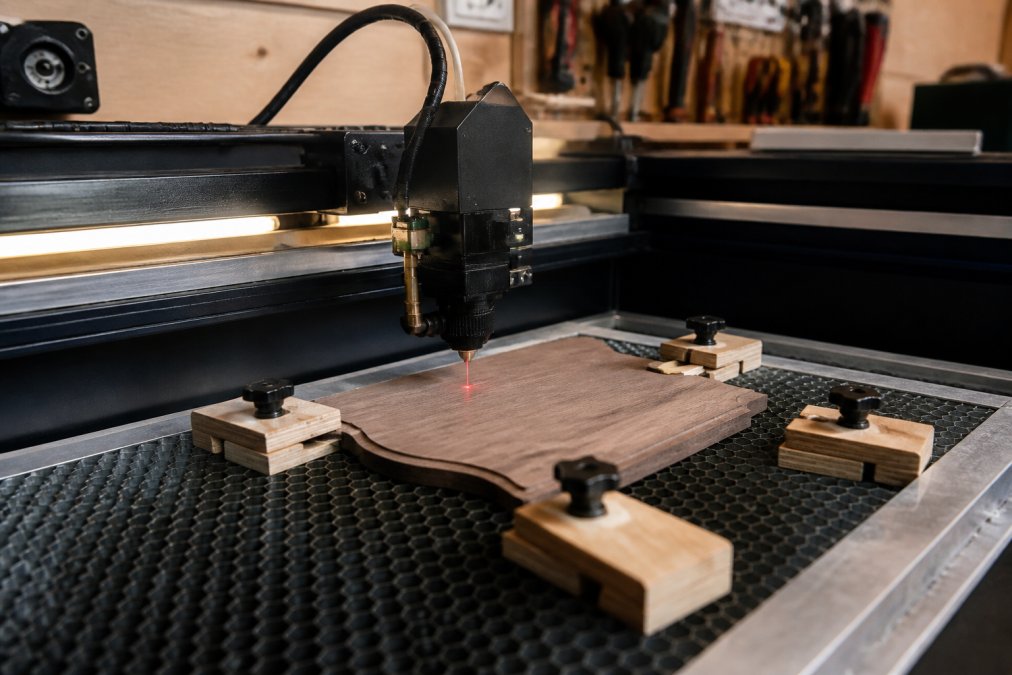
Laser engraving setup fees cover the work before production: securing your item, calibrating the machine, and running test pieces. Every new shape or material requires preparation a repeat job does not.
Fixture Fabrication and Machine Calibration
A fixture is a custom holder that keeps your item in the same position for every pass. Without one, a curved tumbler or irregular plaque shifts slightly, and the engraving comes out crooked or doubled.
The Cost of Custom Laser Engraving: Hand vs. Laser, Hourly vs. Per-Piece
The cost of custom laser engraving depends on two decisions: which method you choose and how the shop bills you. Hand and laser engraving carry different labor profiles, while hourly and per-piece pricing suit different order types. Understanding each mechanism lets you predict a quote before you ask for one.
Hand Engraving vs. Laser Engraving: The Labor Profile Behind the Price
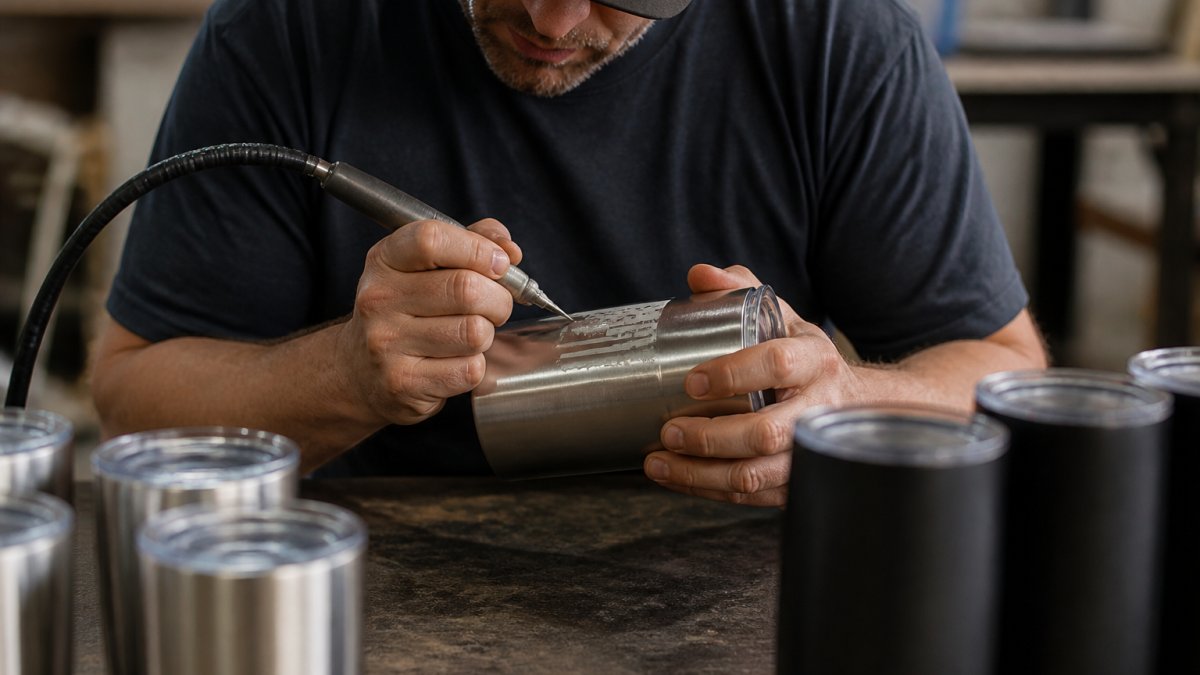
Hand engraving uses a cutting tool guided by a skilled craftsman. The graver is pushed through metal or wood by hand, and the depth, width, and taper of every cut is controlled by wrist pressure and tool angle. That is why hand engraving produces a depth and character a machine struggles to match: the cuts vary slightly, and that variation reads as warmth rather than error.
Pricing Models: Hourly Rate vs. Per-Piece Pricing
Shops generally use one of three pricing models, and knowing which applies to your order helps you compare quotes fairly. The model reflects how the shop recovers its fixed costs.
| Pricing Model | How It Works | Best For | Watch Out For |
|---|---|---|---|
| Hourly rate | Billed for actual machine and labor time | Complex one-offs, prototypes | Costs rise with design complexity; ask for an estimate range |
| Per-piece pricing | Fixed price per unit, setup folded in | Repeat orders, bulk runs | Setup may be hidden in unit price; ask what the reorder price is |
| Hybrid | Setup fee plus per-piece rate | Mixed and volume orders | Ask which costs are fixed and which scale with quantity |
Hidden Overhead Costs and Material Waste in Custom Engraving
Hidden overhead costs are expenses a shop absorbs on every job but rarely itemizes: equipment maintenance, electricity, software licenses, waste disposal, and time spent answering questions and revising proofs. They are built into every quote whether you see them or not.
The Psychology of Perceived Value: Why Custom Feels Worth More
Custom items feel worth more because they carry meaning a mass-produced object cannot. An engraved award marks a specific person and achievement; a personalized gift signals that someone took the time to make it about you. That perception follows predictable mechanisms that explain why customers pay a premium unrelated to the cost of metal or machine time.
Scarcity and Exclusivity
A mass-produced item exists in thousands of identical copies; a custom-engraved piece exists in a run of one. That scarcity changes how the owner values it. A few-dollar blank plaque becomes worth more once it carries a name that appears nowhere else. The premium is not for the material; it is for the fact that no one else owns that exact object.
The Effort Heuristic
People read effort as a signal of care. When a recipient learns that someone commissioned a piece, approved a proof, and waited for it, the gift carries evidence of intent a store-bought item cannot. This is the effort heuristic: we assume something requiring more work is worth more, and we are often right.
Identity and Self-Expression
Custom engraving lets the owner put their own mark on an object. A monogrammed flask, a name-engraved watch back, or a company logo on a recognition award turns a generic product into a statement of identity. That is why the same item commands a higher price personalized: the buyer is purchasing a version of it that belongs to them.
The Risk Premium for Irreplaceable Items
This is the part most pricing guides skip. When the item being engraved cannot be replaced, a family heirloom, a vintage watch, a one-of-a-kind firearm, a piece of jewelry with sentimental history, the shop carries a risk a mass producer never faces. If the engraving fails, the shop cannot pull another blank off the shelf; the customer's irreplaceable object is ruined.
Why This Matters When You Read a Quote
Understanding these mechanisms changes how you judge a price. A high quote for a simple engraving may reflect the item's risk, the effort the shop expects to invest in proofing, or the exclusivity the customer is buying. A low quote may mean the shop is cutting corners on artwork preparation or skipping the proof.
Volume vs. One-Off Pricing: When Custom Engraving Gets Cheaper
Custom engraving gets cheaper per unit as volume rises, because the fixed costs of setup, fixture fabrication, and artwork preparation get divided across more pieces. The tenth identical item costs far less than the first, since the machine is already calibrated and the fixture exists.
- Single item: You absorb the full setup, artwork, and fixture cost alone.
- Small batch (roughly 10-25): Setup spreads out; per-piece cost drops noticeably.
- Bulk order (50+): Setup becomes a minor line item; batch processing and saved settings cut machine time.
- Reorder: The fixture and settings already exist, so setup fees shrink or vanish.
Conclusion
The gap between a mass-produced item and a custom-engraved one comes down to setup, labor, and risk a factory never carries for a single order. Understanding those factors lets you read a quote clearly and ask the right questions before you commit.
Frequently Asked Questions
Why is custom engraving more expensive than mass-produced items?
Mass-produced items spread design, setup, and tooling costs across thousands of units. Custom engraving is a one-off process: someone prepares your artwork, calibrates the machine, and runs a single piece. That labor and setup time doesn't get divided down. You're paying for individualized attention, not just materials.
What factors influence the price of laser engraving services?
The main laser engraving pricing factors are material hardness, design complexity, engraving depth, and whether you need vector files prepared from scratch. Setup time, fixture fabrication, and proof approval rounds also add cost. A simple monogram on soft wood prices differently than deep engraving on stainless steel with a detailed logo.
Does the complexity of a design affect engraving costs?
Yes. Complex designs require more artwork preparation, longer machine run time, and sometimes multiple test passes to get the engraving depth and resolution right. Fine details or gradients may need slower machine speed settings, which increases labor time. Simple text or line art is faster and cheaper to produce.
Why do professional engravers charge for setup and design time?
Setup isn't just pressing start. It includes client consultation, creating or cleaning up vector files, fabricating fixtures to hold the item, and running test engraving on scrap material. Laser engraving setup fees cover the work that happens before your piece is touched by the laser, ensuring the final result matches your proof.