 how-to
Personalized Signage for Home Decor: A 2026 How-To Guide
Table of Contents
- How to Plan and Order Personalized Signage for Home Decor
- Step 1: Choose Your Wording and Custom Text
- Step 2: Pick the Right Material for Each Room
- Step 3: Get the Size, Scale, and Placement Right
- Custom Home Sign Ideas for Every Room
- Why Personalized Wood Signs for Home Interiors Work
- Custom Family Name Signs and House Number Signs
- Common Mistakes to Avoid When Ordering Custom Signs
- Frequently Asked Questions
Last Updated: October 5, 2026
How to Plan and Order Personalized Signage for Home Decor
Personalized signage for home decor is custom-made wall art displaying your family name, a meaningful phrase, or an address number, produced from materials like wood or metal and finished to match your interior.
Before you order, answer three questions: where will the sign hang, what should it say, and what material suits that spot? Skip them and you risk a beautiful sign that fits nowhere.
What You'll Need Before You Order
Gather five things before you shop for personalized signage. Each prevents a specific problem later.
- Wall measurements. Width and height of the open space, in inches. Signs look wrong more often from bad scale than bad design.
- A photo of the room. Lighting, wall color, and nearby furniture affect what finish works.
- Your exact text. Spell every name correctly, including apostrophes and capitalization.
For sizing, wall art should cover roughly two-thirds to three-quarters of the width of the furniture beneath it. A sign over a sofa spanning about 60 inches of wall space typically looks balanced at 40 to 45 inches wide.
The U.S. General Services Administration's guidance on accessible design notes that visual elements should maintain strong contrast between text and background.
Step 1: Choose Your Wording and Custom Text
Your wording is the part people read every day, so it deserves more thought than the font. Most buyers start with a family name, and some patterns work well.
Family Names, Monograms, and Initials
A family name is the most common choice for personalized signage and holds up over time. "The Whitfields" or "The Whitfield Family" both work; pick whichever sounds like you say it out loud.
Monograms and initials suit smaller spaces and make strong wedding gifts.
One detail most guides miss: hyphenated names and names with apostrophes need extra care in the proof. Confirm the exact spelling and punctuation before you approve anything.
Quotes, Dates, and Personalized Wording
Quotes, wedding dates, and short phrases turn a name sign into a story. Keep quotes under about eight words so they stay readable from across the room; longer text forces smaller lettering and looks cluttered.
For dates, include the year only; full dates add visual noise without meaning. A short phrase plus the year usually says more than a full sentence.
Step 2: Pick the Right Material for Each Room
Material decides how a sign looks, how long it lasts, and where it belongs. Wood and metal cover most homes, but behave differently room to room.
Wood Signs and Baltic Birch
Wood signs bring warmth to living rooms, bedrooms, and entryways.
Hand-painted and handcrafted wood signs suit rustic and farmhouse interiors. Natural finishes work in almost any room; painted finishes match a specific wall color.
Where wood struggles: high-moisture rooms. A bathroom or an uncovered porch will stress a wood sign over time. Keep wood indoors and away from direct steam.
Metal Signs and Framed Options
Metal signs fit modern, industrial, and outdoor-adjacent spaces, resisting moisture better than wood in kitchens and covered patios. A framed sign, wood or metal, adds a finished edge and visual weight that helps larger pieces feel intentional.
A practical way to choose:
| Room or Use | Best Material | Why |
|---|---|---|
| Living room, bedroom | Wood or Baltic birch | Warm look, fine detail |
| Kitchen, covered patio | Metal | Handles moisture better |
| Entryway or hallway | Framed wood or metal | Finished edge, holds scale |
| Bathroom | Metal, or wood kept dry | Steam stresses wood |
| Outdoors, exposed | Metal only | Weather resistance |
Step 3: Get the Size, Scale, and Placement Right
Size and placement cause more disappointment than design: too small gets lost on a large wall, too large overwhelms the room.
For hanging height, the sign's center should sit at roughly eye level, about 57 to 60 inches from the floor, in a hallway or above a console.
Two more placement rules that save rework:
- Center the sign on the furniture below it, not on the wall, when the two differ.
- Check the view from the main seating position, not just standing at the doorway.
If the wall is large and the sign is the only piece, size up. If it joins a gallery wall, size it to the group.
Custom Home Sign Ideas for Every Room
Custom home sign ideas work best when each piece matches its room's job, wall space, and viewing distance. Here is how we think about placement room by room.
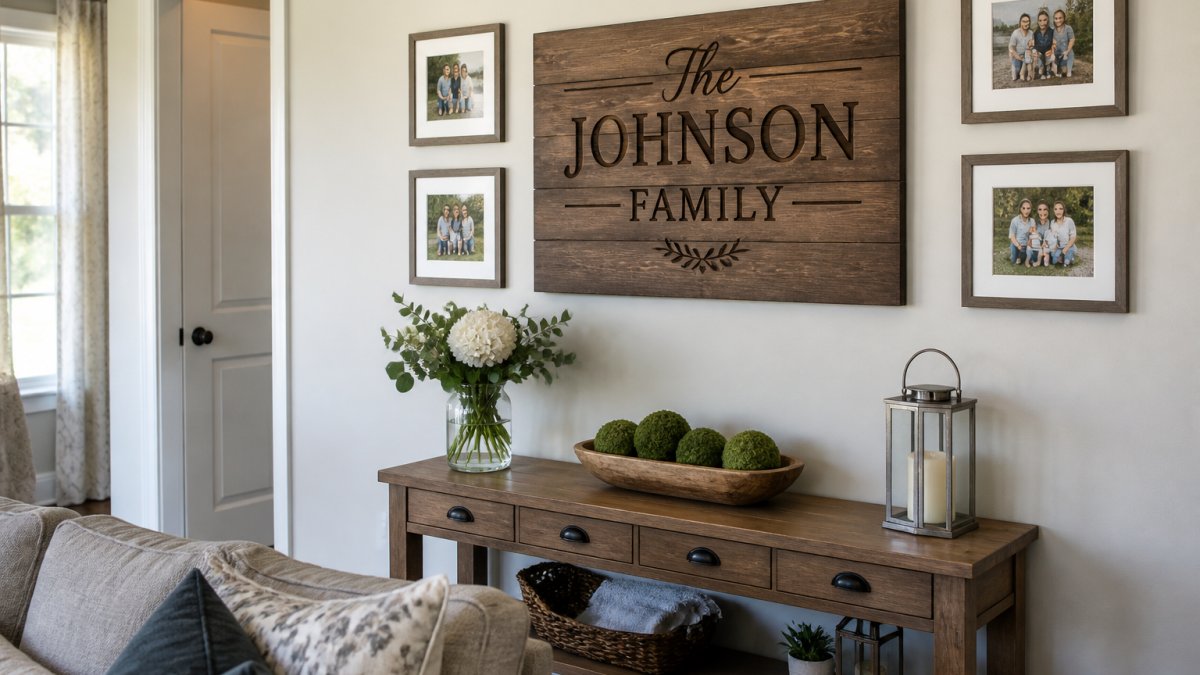
- Living room: a large family name sign above the sofa, in wood or Baltic birch. Size it to about two-thirds to three-quarters of the sofa width, and leave 6 to 10 inches between the sofa back and the sign's bottom. Hang it on two studs or a French cleat rated for the piece's weight.
- Entryway: a vertical sign with a welcome phrase or the family name, sized to the console. Center it on the console, not the wall, when the two differ. A framed piece adds visual weight that helps a narrow entry read as finished.
- Kitchen: a metal sign with a short phrase, placed where steam and splashes are unlikely. Keep it at least a few feet from the range hood and sink spray. Metal wipes clean with a damp cloth; wood in the same spot will dull and lift at the edges.
House number and address signs deserve their own note. The U.S. Postal Service guidance on address formatting recommends clear, correctly placed address numbers so carriers and emergency services can find a home quickly.
Mounting and Care by Room
Where a sign hangs and how it is cleaned matter as much as how it looks:
| Room | Typical mount | Cleaning routine | Watch for |
|---|---|---|---|
| Living room, bedroom | Two screws into studs or a French cleat | Soft, dry cloth monthly | Dust in engraved lettering |
| Entryway, hallway | Keyhole hangers or a cleat | Dry cloth; avoid wet wipes on wood | Door swing and coat hooks |
| Kitchen | Screws into studs; standoffs for metal | Damp cloth on metal; dry only on wood | Steam, grease film, splash zones |
| Bathroom | Metal with standoffs | Damp cloth, then dry | Sustained humidity and steam |
| Exterior | Metal with rust-resistant hardware | Rinse and dry seasonally | Direct sun, freeze-thaw, salt air |
Why Personalized Wood Signs for Home Interiors Work
Personalized wood signs for home interiors work because they do two jobs at once: they fill wall space and they carry meaning. A print or mirror decorates a room; a sign with your family name makes the room yours. But the reason wood holds up indoors is mechanical, not just aesthetic.
What Actually Makes Wood Last Indoors
Three factors decide how a wood sign looks after five years:
- Substrate stability. Baltic birch is a plywood built from thin layers of birch glued in alternating directions. That cross-grain construction resists the warping and cupping a solid plank develops as indoor humidity swings, and takes fine laser detail cleanly.
- Finish type. An unfinished or oiled sign absorbs moisture and skin oils and darkens unevenly. A sealed finish, lacquer, polyurethane, or hard wax oil, resists fingerprints, spills, and grime, and keeps lettering crisp.
- Light exposure. Ordinary room light fades paper prints, but a finished wood sign does not fade the same way. Direct, sustained sun is the exception: it can lighten unfinished wood and dull some stains, so keep a sun-facing piece out of harsh afternoon light or choose a UV-rated finish.
Care and Long-Term Durability
Maintenance for an indoor wood sign is simple:
- Dust with a soft, dry cloth or a vacuum brush attachment every few weeks; dust settles into engraved lettering and dulls contrast.
- Wipe smudges with a barely damp cloth, then dry immediately. Standing water is the enemy of any wood edge.
- Avoid ammonia- and alcohol-based cleaners, which can cloud a lacquer or polyurethane finish.
Cost Factors to Weigh Before You Order
Price for a personalized wood sign is driven by a handful of variables:
- Size. Material cost scales with square footage, and larger pieces often need thicker stock and heavier mounting hardware.
- Material. Baltic birch is a common, cost-effective base; solid hardwoods and exotic species raise the price.
- Finish. A natural or single-color finish is simpler than a multi-color hand-painted design, which adds labor.
There is a design reason too: wood's natural grain adds texture flat materials lack, softening large lettering. A big name sign in wood reads as warm rather than loud, which is why it remains the default choice for personalized signage in living spaces.
Custom Family Name Signs and House Number Signs
Custom family name signs and house number signs are the two most requested pieces, and they solve different problems: the name sign is decorative and personal, the house number sign functional and public-facing.
For family name signs, decide the format first: stacked lines, a single line, or a monogram with the name below. Stacked lines suit narrow walls; a single line suits wide ones.
A short checklist before you approve either:
- Spelling, punctuation, and capitalization confirmed
- Size checked against the wall and furniture
- Material matched to the room's moisture and light
Common Mistakes to Avoid When Ordering Custom Signs
The most common mistakes in custom sign orders are avoidable, with a cheap fix at the planning stage and an expensive one after production.
- Ordering before measuring. Guess the size and you will rehang, return, or live with a sign that never looks right.
- Approving a proof without reading it letter by letter. Names and dates are where errors hide.
- Choosing style over legibility. A decorative font that looks elegant on screen can be unreadable across a room.
When you are ready to move from planning to production, design details matter as much as wording: typography, font, color, background, and size options all shape the final piece. Swift Creek Giftworks offers custom laser engraving services, including proofs before production. Send us your wording, wall measurements, and a photo of the space, and we will turn your idea into a finished piece.
Planning personalized signage for home decor comes down to a handful of decisions in the right order: measure the wall, settle the wording, match the material to the room, and confirm the proof before production.
If you would rather hand the technical side to someone who does this daily, Swift Creek Giftworks offers custom laser engraving with proofs before production and made-to-order craftsmanship from our Garner, NC shop.
Frequently Asked Questions
How do I choose a personalized sign for my home?
Start with the room and the message. Measure your wall space, pick a material that matches the room's humidity and light, and decide on wording that means something to your household. For example, a kitchen sign might list a family name and est. date, while a bedroom sign could use a monogram. Order a proof before production so you can check spelling, font, and layout.
What materials work best for indoor decorative signs?
Wood, especially Baltic birch, is popular for warm, rustic or modern looks and holds laser-cut detail well. Metal signs suit industrial or contemporary rooms and resist warping. Framed signs add a finished look. For bathrooms or kitchens, choose sealed wood or metal to handle moisture.
Where should I hang a personalized sign in my home?
Entryways, above console tables, and gallery walls are common spots. In living rooms, hang signs at eye level or slightly above furniture. Bedrooms work well with smaller monogram signs. For house numbers, place them where they are readable from the street. Use the 57-inch rule for hanging height in main living areas, and always anchor into studs for heavier signs.
Are personalized wood signs suitable for every room?
Wood signs work in most rooms, but humidity and direct sunlight can affect them over time. Bathrooms and kitchens benefit from sealed finishes. Bedrooms and living rooms are ideal. For outdoor use, choose weather-treated wood or metal.